WHY SOAR?

SOAR has a serious side in its missions to help kids find ways of helping the ocean and watersheds throughout the world. I started on having seen hundreds of albatrosses killed by plastic debris at Pihemanu (Midway Atoll). I was inspired by the questions of young people in Ohio and by USFWS biologists working hard to protect endangered species and damaged habitats.


SOAR has a very fun and tough to define side.....thanks to FRED AND FRIENDS, Project SOAR helps with watershed and ocean workshops throughout the world, and generally makes people smile while they learn some tough stuff about how we treat our rivers, streams, lakes, ponds, and the one ocean on planet earth..........

INVITING SOAR INTO YOUR SCHOOL, ORGANIZATION, AND COMMUNITY

SOAR introduces young people to ways they can make a difference in their local community and the wider world.


Take advantage by:


1) Invite a SOAR learning kit or bring Ron Hirschi to your school as a guest author or speaker for your organization. Ron has many years experience as an author and as a biologist. SOAR adds another dimension to his list of hands on projects he shares in writing, art, and ecology workshops.


Many schools invite Ron for his work as author of more than 50 nonfiction books, including many with ocean themes. Others bring him to school as a scientist or artist, but the best fit is always when schools use Ron to help them integrate curriculum.


Tom Bates, Principal at Tremont Elementary in Ohio recently said in an interview following Ron's visit, "What stood out to me was how Ron was able to gear his activities and discussion and information so it was meaningful to the students, whether they were in kindergarten or fifth grade."


Be in touch at whalemail@waypoint.com for visit information.


2) SOAR now has a new kit circling the globe along with a Laysan Albatross "Friend of Fred". This duo is packaged with a box full of ideas, activities, information about Papahanaumokuakea, ocean debris, and other materials aimed at sparking new projects related to the sea. Also included is a journal chronicling Fred's adventures, all of which began when kids at Columbus School for Girls (CSG) learned how they could take action to help the ocean.


Currently, this treasured package is in the hands of The Bush School in Seattle.


NOTE: You might also be lucky to receive one of the earlier packages with a FRED and Friend, already traveling. To date, Fred has visited Australia, Switzerland, Israel, England, The Dominican Republic, and many corners of the United States.

12 October 2009

Postcard From Fred: CINCINNATI RULES!!!


Yep, that's me, Fred the Monkey, with kids in Cincinnati. Well actually we were up on the Little Miami River in the Mariemont Schools.......Did you know this is home of Graeters! And they have pastry plus their super ice cream. I think my buddy, Ron is still down there eating some blueberry buckle with black rasberry chocolate chip ice cream on top....But hey, we got some serious good science to report.

I mostly watched from the riverbank, but buddy Ron with super help from Sandy and Judy at the seine poles netted with the kids. They actually caught that awesome GAR --- Yep, it's long and skinny like a banana, but me, I stayed away. BIG, SHARP TEETH in that long nose. But it was a very friendly Gar. AND, Check this out: The kids caught all totaled in the Little Miami River:

1,415 Fish plus dragonflies, damselflies, lots of caddis, some stoneflies, frogs, a toad, crayfish, snails, tons of clams and mussels, and saw herons, an osprey, kingfishers, swifts, and lots of sticks chewed by beavers.......

Even better than numbers, we got lots of DIVERSITY. Biodiversity is where it's at. Kind of like rainforests that still have many kinds of species, the Little Miami River has a ton of diversity in its fish community. I know because I talked to the fish. They do not like bananas! Good for the fish. Good for Fred.

We caught 16 different kinds (species) of fish:

Five kinds of darters (Darters really need clean water, so they tell us a stream is healthy)
Catfish
Bluegill (Jimmy got it!)
Two kinds of suckers
Three kinds of Shiners
Smallmouth bass
Grass Pickerel
Creek Chub
Gar (How cool was that - the 21 incher in the photo and a 23 incher too. Both friendly.)

All this means a lot. PLUS There was almost no trash along the stream. We only saw one old water bottle. Maybe it's because back at school I, Fred the serious Monkey who means business, saw recycling....Hmmm. Maybe communities that recycle take better care of their rivers and the distant ocean.

Hey! I also heard good things back at school. Kids were very curious about Pihemanu. They want to help the ocean and the albatrosses. Some even started imagining new inventions to take the place of plastic. Like how about refillable, metal marker pen sets??? Sounds good. Let's send a letter to Crayola about that one!

Thanks Mariemont! Go Bearcats!

Your Pal, Fred

28 September 2009

IN MEMORY OF X310


She was born in March.
Her world was once the most beautiful and remote place on earth.
Pihemanu. Aka Midway Atoll within Papahanuamokuakea.
She died in June.
She didn't have much of a name. A number, really. X310.
Tagged by devoted biologists, she became a statistic.
Laysan Albatross.
 Died before fledging.
One of the most incredible birds on the planet.
Adults fly more than a million miles in their lifetime.
X310 did not get to soar over the Pacific.
X310 died like thousands, millions actually, of other seabirds.
Plastics float to the sea from Ohio, California, and all corners of the earth.
Plastics find their way into food webs and lead to deaths we do not see.
But many of us are now watching over the ocean in new ways.
Listen. Read. Check ocean sites and imagine a new way of living, plastic free.

X310's leg band is worn by a silly little Monkey named Fred.
Fred is a Monkey who means business.
He tells a good story and talks up and down the coast and all across the country.
He knows the world of X310 and asks all to take responsibility.
 Kuleana in Hawaiian. Responsibility.
Responsible actions could have saved X310.
She was a beautiful young bird.
But there were no vets, no shelters, no humane societies protecting albatrosses.
No one, not even the most caring animal lover could have saved her when she ate plastic.
Everyone, each of us, could prevent future loss.
Live plastic free.
In memory of X310.

(See X310 Ocean Activity below)

POSTCARD FROM FRED


Where's me, Fred the Monkey?

I'm right here with kids at Highland Park Elementary in Grove City, Ohio. We just went down to Marsh Run. That's Ohioan for Creek.

We caught all kinds of Darters and some minnows and creek chubs too.

I went over to Monterey Elementary too. All us kids went to Brown Run and caught a bunch of fish too and a giant bullfrog.


Here's our Bullfrog! Thanks to a Monterey Dad we caught lots!
Sure Great to have Moms and Dads in the Creek with us Kids and Me, Fred.

Catching Darters means good water in Marsh Run because Darters need lots of oxygen in their streams. Darters are little fish and they are very beautiful. Looking for them is really important in Ohio. Maybe Brown Run needs some water quality help because we didn't see any darters there. BUT KIDS NOTICED THIS: There was so much trash in both streams - bottles, toys, plastic bags galore - that kids decided to write to the mayor about a cleanup and kids in Mrs. Hootman's 4th Grade Class promised to start up a recycling project at school.

Back in Hawaii, I, Fred the Monkey, learned that one thing is important: Kuleana. That means Responsibility and all us at Highland Park and Monterey are gonna take responsibility to make sure our streams are clean. That way, the plastic doesn't flow on down the Brown and Marsh Run to the Scioto, to the Ohio and on to the Mississippi to the ocean. All my Albatross friends will be happy to hear that. Thank you Mrs. Hootman's class and all you kids in Grove City. You sure were fun to go creeking with!    Your Buddy,  Fred, The Monkey Who Means Business. Ocean Business.

26 September 2009

SERIOUS SAND UPDATE

Thank you to all who have sent sand samples from all corners of the oceans, Atlantic and Pacific.

I hope you might continue to send samples, especially from Fall and Winter Beaches. I will collect sand on Kauai in October and hope to receive more from others of the Hawaiian Islands during the stormy season when beaches change so dramatically. I'll also post results of a study of the unidentified black specks as soon as that is available. There was thought of the black particles being mica, but comparison with mica flakes in sand from Maine leaves much doubt of that explanation of the "mystery objects".

As an update, here is a list of all the beaches at which micro plastic and/or styrofoam was identified from samples from June through September 2009. Keep in mind that the samples were taken by many individuals and represent an incredibly small area of each site. Most samples were single scoops the size of a film cannister. Imagine how much we missed on these and on the other beaches where no identifiable plastic was observed. Here are the beaches along with a suggestion for helping change this world wide problem:

Mackeral Cove Beach. Jamestorwn, Rhode Island
Atlantic City, New Jersey
Fort Lauderdale, Florida
Seascape Beach, California
Columbia River Near Mouth, Oregon
Ocean Shores, Washington
East Beach, Marrowstone Island, Washington
Marrowstone Point, Washington
Hilo Bay, Big Island, Hawaii
Waimanalo Beach, Oahu, Hawaii
Pihemanu, Midway Atoll, U.S. Territory

If you live near any of these beaches, consider organizing a beach cleanup and/or adopting the beaches in the vicinity. I've been doing this for several years on Marrowstone Island. I also posted a notice with photograph of trash on the beach at our local store, hoping to encourage people to help stop the flow of trash.

If you live inland, please consider adopting a small stream or riverbank. I was just in Ohio and saw streambanks covered with plastics of all descriptions near schools that do not recycle. So, for all those of you living in places where recycling is second nature, know that we have a long way to go in making sure plastics don't end up flowing into watersheds instead of good reuse programs.

Thank you again to all who have expressed interest in the serious sand project. There is much to be done to stop the flow of plastics into the sea. Cleaning it up is not the final solution.   

18 September 2009

SOARING WITH FRED. THE JOURNEY BEGINS......


It's me, Fred. That's my buddy, Monsoon. She's a Labrador and she helped me retrieve all this from the beach here on Marrowstone Island, Washington State USA. Flip flops, cell phones, toys, bottles, and 38 bottle caps on Labor Day.......lots of fresh plastic headed out to the bigger ocean.

Me, Fred, little me.......I think I have a job to do. I got to visit Pihe Manu, Midway Atoll with my buddy Ron. We went out there with so many good people who are now teaching others about the troubles of our oceans. We helped a guy start some film projects too. And now, I'm headed out to the bigger world.

Some of you have read the story of Evelyn. She is so very cool. She and her friends asked a lot of questions about Papahanaumokuakea Marine National Monument, the ocean, and the troubles with plastic. This gave me the idea of making up a journey and taking along some ocean activities.

I saw all this plastic here at my home on beautiful Marrowstone Island. Nobody seems to care much about the beaches here. From my studies of Serious Sand, it seems that nobody cares much about beaches any place on earth. That is sad for me and a tough story for me to tell to you. But, hey, I'm a Monkey and I want to be part of helping the planet for all of us. I met a whole lotta Albatross friends out on Midway Atoll and they told me to spread the word about plastic pollution. It really hurts them and their babies.

So, here I go out to the world. SOARing first to Columbus, Ohio USA. I'm starting there because I know something special. Oceans are so very beautiful. But Rivers are too and the rivers lead to the sea. So, I get to talk story with kids in Ohio about how the Scioto River goes to the Ohio and on to the Mississippi, then into the Ocean.

Last spring, I heard this beautiful story in Dublin, Ohio. I was hearing it from these special people who all went home one morning and got a little bit of water from their house and brought it down to St Brigid of Kildare where they all poured the water into a common bowl.........all water as one. That's how the ocean is -- one Ocean and it needs our help.

My next stop will be down under. I got invited to visit Aroona in Queensland, Australia!!! I hope those kangaroos don't like bananas. I hope I will learn what people are doing in Australia to help the sea. But it sounds a little scary. I saw someplace they have this thing called the Great Bear Reef. Yikes. Big bears all lined up along the shore??? Gotta find out more about this deal for sure.

Keep in touch right here. My sister Coco is staying home to take care of my buddies here on Marrowstone. She will keep cleaning up the local beach and talk story with my buddy Ron.

Watch for POSTCARDS FROM ME, FRED.

I'm looking for a good place to visit when I come home from Australia, so write to me or get in touch with my sister, Coco. She's the brains behind all I get to do........I just go for it. Somebody's gotta save the world!

Malama i ke kai !!! Protect the Ocean..........       

Aloha,   Fred      

20 August 2009

OFF TO WORK


School is back in session and the morning commute might be your best time to think about the day ahead. Maybe it takes you half an hour or even an hour each way. Think of the time you would have if you were able to commute with an Albatross.

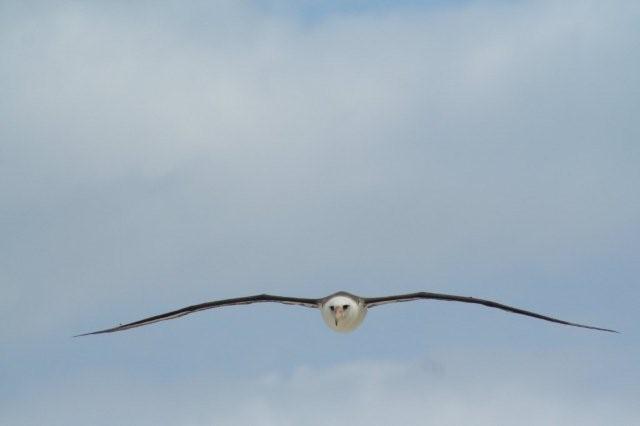
The photo above is a Laysan Albatross, just leaving Sand Island at Midway Atoll.

During the nesting season, both albatross parents feed their young. Each parent will leave once a week, communting to Bering Sea fishing grounds for a few days before returning to feed their chick. Each flight might take them 800 miles or more away from Midway. Trips of more than a thousand miles to get one meal for the little one are common.

Now that summer is about over, all the Albatross leave Midway. Adults will not return until the next nesting season. In the time away, they search for food while covering thousands of miles of open ocean. Some Albatross will reach the west coast of the United States. Most will fly as many as a million or even three million miles in their lifetime.

Like salmon returning to the stream of their birth, Laysan Albatross adults come back to the same location to nest year after year. On Sand Island, these nesting spots are littered with the past remains of lighters, toys, and other pieces of the 5 tons of plastic the birds bring back every year. Five tons of plastic fed to young ones by the adults.

To grasp the numbers more clearly, I've been turning to the art of Chris Jordan. His imagery helps to envision just how much plastic is entering the sea each day. Makes it easier to imagine how an Albatross can find so much of it bobbing around on the waves, looking like something good to eat. Click on the "In Your Consumer Face Art" link above to see some of Chris Jordan's work and look forward to what he comes up with after visiting Midway Atoll.....

I seem to be spending more and more time the past couple of weeks picking up fishing line, bottles, empty sun screen containers, and other debris along the beach here on Marrowstone Island. Lots of summer visitors are still around and they leave a lot on our beaches. The endless stream of plastic drifts away from the beach just as the Albatrosses are leaving Midway and heading to our shore.

I'm told that the plastic industry poured enough money into a campaign to stop the City of Seattle from limiting the use of plastic bags in retail stores. Maybe it went down to defeat because the city wanted to impose a tax on each bag used. The vote was just yesterday. Maybe some of you will come up with a better way than taxation to stop the use of plastics. Think on it on your morning commute.

10 August 2009

POSTCARDS FROM PAPAHANAUMOKUAKEA

Why is Papahanaumokuakea important to Native Hawaiians?

How much garbage do you think is in the Eastern and Western garbage patches and does this affect people?

Has global warming affected the migration of humpback whales?

Did some of the plastic get into the ocean on purpose and if so, why?

How much plastic is accidentally fed to the average albatross chick?

Is there a safe amount of plastic for an albatross to eat? In other words, is there a limit to how much they can safely eat?

What kinds of trash do people most commonly find in dead albatross chicks?

Does the plastic endanger parrot fish?

Can we help organize a research club to help the albatross and the environment?


These are some of the many questions sent to me by kids after they learned I was visiting Midway Atoll this summer. Several teachers told their students about my journey and helped them with research into Papahanaumokuakea Marine National Monument and the issues of ocean health we might encounter at Midway. As you can easily see, the questions above reflect some serious thought. What you might be surprised to learn is that ALL of the above questions are not from high school or college students, they are from Kindergarteners............

The first question was thoughtfully answered by Walterbea Aldeguer in this way: "Aloha, The answer lies in the question, How much do you love your Grandparents?"

Other PAA participants were kind enough to reply to some of the other questions and all of the dozens of questions were answered with hand written and illustrated postcards from Papahanaumokuakea. Biologists on Midway also helped as did whale and seal biologists.

Finding answers was not so easy and no so complete. That is why the last question helped set SOAR in motion as a way to seek solutions to ocean plastic problems and other watershed and ocean issues. SOAR fills a need for young people to find a way to help the ocean and the world around them. The kids want to know answers to our toughest, most difficult questions.

The cousin of one of the participants at Midway wrote a very powerful song that speaks to much of what we feel as we start out with SOAR. Mickey's song, Hawai'i 78, was made popular by Israel Kamakawiwo'ole and it asks us to wonder what our ancestors would think if they came back to see what we have done to their beautiful island home. Check out the song on Iz's Facing Future CD.

Likewise, Jane Siberry implores us to think deeply to make sure we act in ways that malama i ke kai ame ka aina (proect the ocean and land). She looks forward in her beautiful song, Bound by the Beauty. The lyrics demand we do right when she says she's coming back in 500 years and the forests better still be here!!!!! Jane has kindly allowed me to use the lyrics in a book I've been working on for a while about women who have helped the environment. I'm glad I've not submitted the book, knowing now that I must add some of my kindergarten friends in its pages. Young women with great minds, great hearts.

If you are a teacher, by all means ask your kids to ask tough questions and send them to me. I will pass the questions around to knowledgeable scientists or try to answer myself. And, you'll get back hand written and illustrated postcards much like those we sent from Papahanaumokuakea.

X310 Plastic Ocean Activity


It's me, Fred, the Monkey.

If you look closely, you can see I wear X310's leg band around my neck. It's to remind me of her. She was a Laysan Albatross. She was born in March 2008 and lived on Pihemanu, one of the most remote atolls on earth, now part of Papahanaumokuakea Marine National Monument.

You can wonder about Pihemanu and about X310. She didn't live very long, dying in June 2008. Her parents flew thousands and thousands of miles finding food for her. But x310, like lots of baby albatrosses died before she got to soar the seas. Some albatrosses fly three million miles during their life. Like X310's parents, their sea is a new challenge in food finding because of our actions on land.

Adult albatrosses fly more than a thousand miles just to get a single meal for their babies. But the ocean is full of plastic. And if you read my buddy, Ron's blog and website, you learn about plastic in the sea. It is everywhere and babies like X310 die because they eat so much plastic, they can not get it out of their stomachs.

Where's all this plastic come from?
Where does it go?

Here is a simple activity:

Get up from your chair and walk around the classroom or wherever you are sitting.

Write down each thing around you that is made of plastic.

Everybody compare lists and make a total of the plastic products.

Now, the hard part of this activity:

Can you find alternatives for the things you use, alternatives not made of plastic?
Maybe start with drinking water from a fountain or glass or reuseable container?
Maybe start a really good recycling project?
Maybe make some art from recycled plastic?
Learn more on links here on this site and others.
Talk about times with no plastic.
X310 would have appreciated if people, just a few years ago had decided to make a plastic-free world for you....
You and X310.

Learn how you can SOAR with FRED by arranging a visit with Fred and his ocean teaching kit by emailing his banana provider at whalemail@waypoint.com

FEEDING A BABY ALBATROSS OCEAN ACTIVITY

What you need:

Pint size plastic beverage container with wide mouth (about 1.5 inches) ---This approximates the size of a baby albatross stomach and esophagus.

Important to have the lid too.

Enough plastic items (bottle caps, toothbrush, legos, fishing line, small chunks of nylon rope, markers, pens, more bottle caps and even a few more bottle caps since they are pretty much the most common marine debris.

Talk with your audience of kids of any age about ocean debris and the way adult albatrosses fly out a few hundred or even a thousand miles to find flying fish eggs and squid for the little ones. They return to Pihe Manu or up on the Northeast shore of Kauai, find their young one among thousands of others and begin to feed by regurgitating "food".......

As you talk about this, have the kids place one or two pieces of the plastic into the bottle.

Replace cap with each addition of plastic. Shake gently to mimic bird moving around the nesting area a bit.

Remove cap. Shake gently to mimic the bird trying to dislodge "food" that can not be digested. In a perfect ocean, this would be squid beaks, fish bones, or other natural pieces of food.

Add more plastic, repeating above until no plastic falls out of the bottle when cap is removed (bill is opened) and the bird tries and tries, but can not toss up the mass of debris. See how much and how many different kinds of plastic can be added. Does the rope tangle with the legos and bottle caps. Do five bottle caps cause a blockage in the esophagus???

In nature, the upchucked mass is like an owl pellet and is known as a bolus. Natural foods slip freely through the esophagus and more feeding can continue. Most times, a baby albatross will toss up one bolus before leaving the nesting island. Unfortunately, thousands die because plastic blocks the stomach completely.

Your feeding the baby albatross activity can lead to a lot of discussion of plastics we use, discard, then find their way into the ocean and into the mouth of a baby albatross.

If you want to have a Baby Albatross Feeding Kit, complete with some plastic items that actually came from once living albatross at Pihe Manu, Papahanaumokuakea, be in touch.